
Human Rights Education
Our Story
By Duncan McNair, founder of Peaceful Planet
My grandfather and the Iranian oil dispute
Peaceful Planet Human Rights Education has its origins in the 1950s, when a disagreement between the democratically elected Iranian Government and the western oil industry brought my grandfather, Sir Arnold McNair, later Lord McNair, into playing a key role as President of the International Court of Justice (ICJ) at The Hague, Holland. This set in motion a train of events whose reverberations have continued until the present time. The International Court is the United Nations court that settles legal disputes between states.
The British Government’s response to the nationalisation of Iran’s oil by the Prime Minister, Mohammed Mossadegh and his democratically elected government was to bring proceedings at the ICJ. For anyone interested in the international law aspects of the case, details are available on the ICJ website at https://icj-web.leman.un-icc.cloud/case/16/judgments. Sir Arnold McNair wrote an individual legal opinion supporting the judgment but for different reasons than that expressed by the majority verdict – Read Sir Arnold McNair’s individual opinion. Rights, national sovereignty, and national dignity were important factors in that dispute. Sir Arnold took a stand in support of those principles and is remembered in Iran to this day for what he did.
I had previously met Ali Reza Saheb who had been Prime Minister Mohammed Mossadegh’s Private Secretary at the time of the oil crisis. Ali Reza Saheb had told me that Sir Arnold had been a national hero for Iranians at the time. He expressed the view that if he had been invited to Tehran, and had managed to broker an agreement between the parties, the whole history of Iran since 1952 could have been very different.
After the Council of Europe (a different international organisation from the EU) was founded in 1949, and the European Convention on Human Rights was formally adopted in 1950, Sir Arnold argued strongly in favour of a Court to uphold the Convention. The European Court of Human Rights was founded on 1959 and Sir Arnold became its Founding President.
A family commitment to human rights
Duncan McNair’s father, as the second Baron McNair, was a Liberal Party delegate to the Council of Europe and continued a tradition of support on human rights matters. He cosponsored the first UK legislation to outlaw FGM in the UK in 1983, supported the Baha’i Faith community when they were being severely persecuted after the Islamic Revolution in Iran in 1979 and helped to resolve a funding crisis for the Palestinian Refugee camps in 1983 as a member of the Council of Europe.
From a conversation to 170 workshops
Peaceful Planet Human Rights Education many years later grew out of a personal connection with those events in the 1950s. A request in 2014 to talk to a Farsi language discussion group in London about Sir Arnold’s role in that intense geopolitical drama, and about human rights in the context of those years led to my organising 170 workshops on the Universal Declaration of Human Rights in London, most delivered in Farsi.
From human rights to human dignity
While teaching human rights, it became increasingly clear that laws and rights alone do not explain why people treat one another with respect or contempt. This led to a deeper exploration of human dignity and the work of Dr Donna Hicks on human dignity and her 10 elements of dignity and 10 temptations to violate dignity
The additional focus on dignity gradually developed into broader interests in how education, systems, institutions, science, and community participation affect the ability of individuals and communities to live with dignity, capability, and meaningful agency.
Understanding dignity raised wider questions. What enables people to participate effectively in society? Why do some communities flourish while others struggle? What role do education, science, institutions and community participation play?
One of the Objectives of Peaceful Planet is: To provide education that empowers, enhances and activates individuals and communities to implement their human rights.
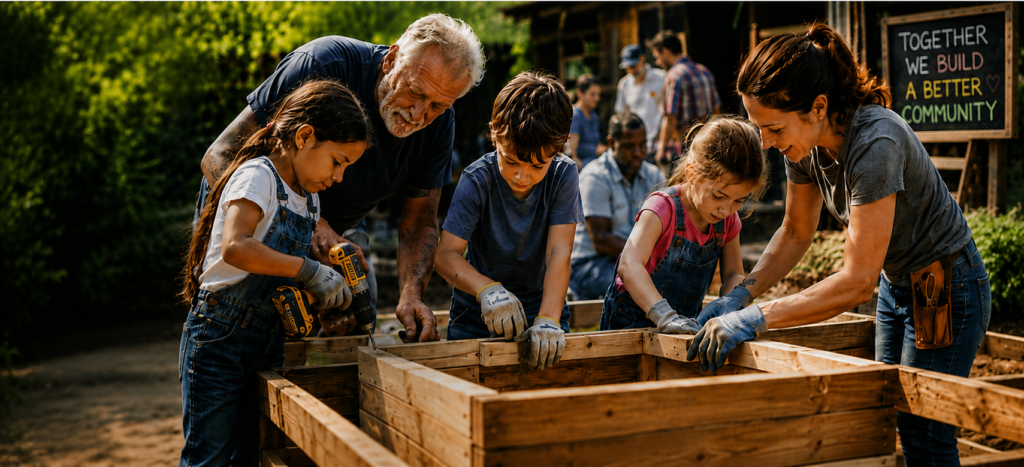
That purpose connects our educational resources with the practical community work described throughout this website.