
Topic 2: 4 Universal Principles for Maintaining the Rule of Law
The World Justice Project (worldjustice.org) gives four universal principles for the rule of law to be maintained. It defines the Rule of Law as a durable system of laws, institutions, norms, and community commitment that delivers:
- Accountability
The government, as well as private actors, are accountable under the law. In other words, they must not break the law. - Just Law
The law is clear, publicised, and stable and is applied evenly. It ensures human rights as well as property, contract, and procedural rights. - Open Government
The processes by which the law is adopted, administered, judged, and enforced are accessible, fair, and efficient. - Accessible and Impartial Justice
Justice is delivered timely by competent, ethical, and independent representatives and neutrals who are of sufficient number and have adequate resources.
The Rule of Law Education Centre in Sydney, Australia, has created an intriguing and insightful graphic with the following points which need to exist for people to have the protection of the Rule of Law:
From the Rule of Law Institute, Sydney, Australia
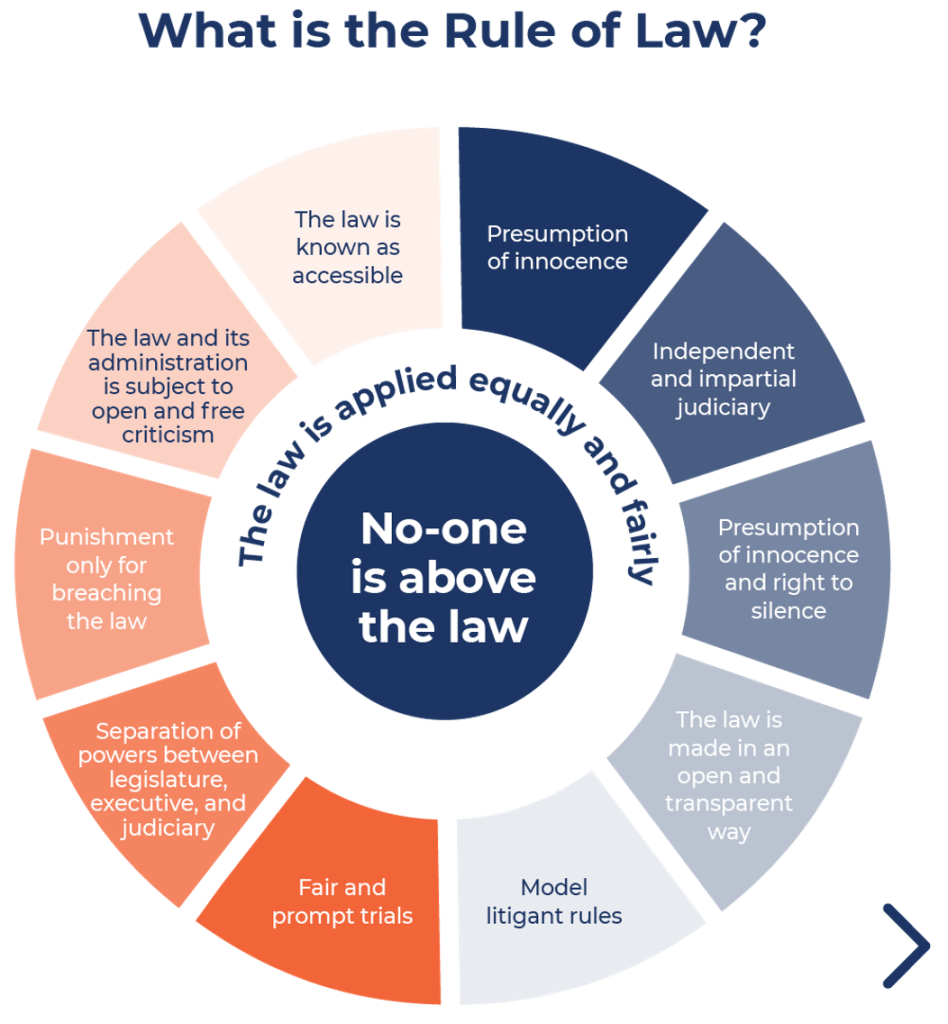
Presumption of innocence – you are considered to be innocent until you are convicted of a crime
Independent and impartial judiciary – judges are neutral and unbiased
Right to silence – you have the right to remain silent and not give evidence that might make you seem guilty of the crime you are charged with.
The law is made in an open and transparent way – laws are made in a freely elected parliament and are subject to scrutiny, debate and voting by elected representatives.
Model litigant rules – guidelines for how a government ought to behave before, during, and after litigation with another government body, a private company, or an individual.
It is vital that government bodies should not be ‘out to get’ people but should be acting in the public interest, according to law. These guidelines seek to address an inherent and substantial power imbalance, from the Rule of Law Education Centre https://www.ruleoflaw.org.au/principles/model-litigant-rules/
Fair and prompt trials – people should not have to wait for their cases to be heard, whether they are accused of a crime, or they are a party to a civil dispute
Separation of powers between the legislature, executive and judiciary (lawmakers, government ministers and judges) – Separation of powers refers to the division of government responsibilities into distinct branches to limit any one branch from exercising the core functions of another. The intent is to prevent the concentration of power and ensure there are checks and balances.
For example, the EU Commission is the executive branch of the European Union which is the European Government over 26 nations. It has much more power than the European Parliament, which tends to ‘rubber stamp’ its decisions, a situation that has its roots in the Second World War.
Punishment only for breaking the law – arbitrary punishment at the whim of a judge, government official, police officer or military unit is prohibited
The law and its administration are subject to open and free criticism – when those in charge stifle criticism, it is an indication that they have past or current actions which violate the Rule of Law and that they do not want people to know about.
The law is known as accessible – The law must be known and predictable so that all people are able to be guided by it and know clearly the consequence of their actions. The laws must also be comprehensible and clear with limited government discretion so that the laws are applied predictably and in a non-arbitrary manner. Finally, all individuals must have access to justice (from Rule of Law Education Centre)
Laws are not made that have a retroactive effect – A retroactive law operates as of a time before the law was passed. It, therefore, operates backwards in that it changes the law from what it was so that something that was not a crime when the action was done becomes a crime at a later date.