
Topic 3: The 10-Stage Model for Genocide
STAGE 1: Classification

Victims are identified and separated into categories. Death lists are drawn up. The lists provided to the Nazi regime by IBM’s German subsidiary, known as Dehomag, from their punched card system made possible the minutely detailed and methodical work that went into creating what we know as the Holocaust. Edwin Black explores this in his book, IBM and the Holocaust. IBM’s punched card system (an early form of computing) was utilised for a contract with the Nazi regime to classify the population of Germany minutely and later the populations of the conquered territories of eastern and western Europe so that they could be assigned to slave labour work, murdered in the gas chambers or other mass killing exercise. Oliver Burkeman wrote for The Guardian, “The paperback provides the first evidence that the company’s dealings with the Nazis were controlled from its New York headquarters throughout the second world war.”IBM tells a part of the story on its website:
Perhaps the earliest icon of the Information Age was a simple punched card produced by IBM, commonly known as the “IBM card.” Measuring just 7- 3/8 inches by 3- 1/4 inches, the piece of smooth stock paper was unassuming, to be sure. But taken collectively, the IBM card held nearly all the world’s known information for just under half a century—an impressive feat even by today’s measures. It rose to popularity during the Great Depression and quickly became a ubiquitous instalment in the worlds of data processing and popular culture. What’s more, the punched card provided such a significant profit stream that it was instrumental to IBM’s rapid growth in the mid-twentieth century. So, like many of the large German corporations, IBM expanded its operations from the enslavement and murder of millions of Europeans under the Nazi regime.
From the Guardian review of the paperback edition, Black wrote in the Jerusalem Post that, When the Nazis invaded Poland, , “IBM New York established a special new subsidiary called Watson Business Machines,” after its then-president, Thomas Watson. “IBM’s new Polish company’s sole purpose was to service the Nazi occupation during the rape of Poland.” Watson Business Machines even operated a punch-card printing shop over the street from the Warsaw Ghetto, the paperback claims.
Robert Wolfe, a researcher on Mr Black’s team who was formerly in charge of Nazi documents in the US national archives, said the new details would silence detractors.
“The word has gotten out, and a lot of people still alive are supplying information that they didn’t have the context to understand before,” he told Reuters. “For those who have complained the proof is not there, this leaves little room for deniability.”
From BESA Center Perspectives Paper No. 1,935, February 18, 2021
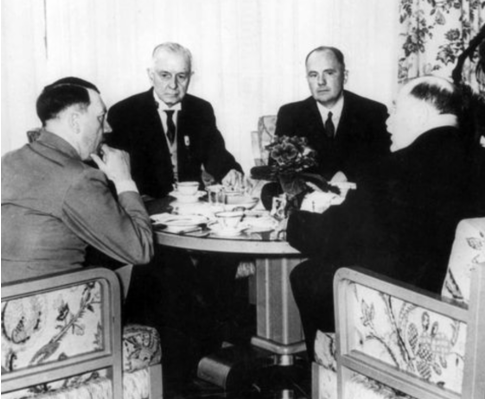
IBM CEO Thomas J. Watson (second from left) meets with Hitler in Berlin, June 1937, just before receiving medal for “service to the Reich”; image via Jewish Virtual Library
EXECUTIVE SUMMARY: Twenty years ago, Edwin Black’s book, IBM and the Holocaust, exposed—backed up by a tower of documentation— that IBM knowingly organised all six phases of the Holocaust: identification, exclusion, confiscation, ghettoisation, deportation, and even extermination. All of this occurred under the micromanagement of IBM’s celebrated CEO, Thomas Watson, Sr., operating from his New York office on Madison Avenue and later through European subsidiaries. In view of what IBM was able to accomplish on behalf of the Nazis prior to the era of the computer, the thought of what big tech can now do to surveil, censor, and control human lives is sobering indeed.
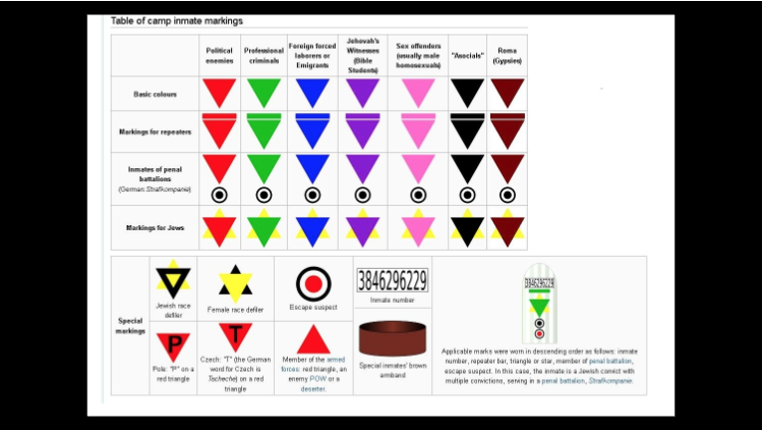
This is an example of the information IBM provided for the Nazi regime.
Prevention requires
- Early warning
- Rapid response
- Courts of accountability
STAGE 2: Symbolization
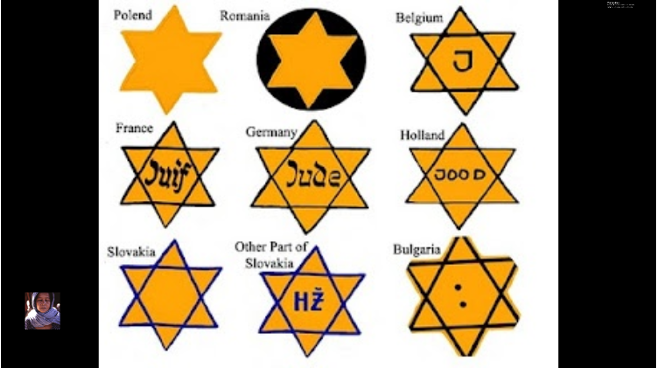
Classifications are symbolised, and groups are given names and other symbols.
Prevention requires
- Search for common ground (church, sports, music, schools
- Promote transcendent identities like nationality and humanity
STAGE 4: Discrimination
Dominant group uses laws, custom, and political power to deny the rights of other groups
Examples are the Nuremberg laws of 1935 in Nazi Germany from https://www.tutor2u.net/history/reference/nuremberg-laws
Nuremberg Laws
The Nuremberg Laws were laws which were passed by the Nazis that targeted Jews and placed restrictions upon their movements, rights and lives. They were passed on 15th September 1935. Among the wider changes to German society, there were two laws that specifically targeted Jews.
The Reich Law for the Protection of German Blood and Honour (Reich is German for ‘State’.
The Protection of German Blood and Honour surrounded the issues of marriage and childbirth. Under this law, Jews were prohibited from marrying Germans, and were also prohibited from engaging in sexual relationships with them.
The Reich Law on Citizenship
Perhaps the more significant of the two laws, this law stripped Jews of their German citizenship. Jews were defined as subjects of the Reich rather than citizens, and the law backed this up with the statement that those having German blood were entitled to be citizens. This was linked to Nazi ideas about clean and dirty blood. This law also required Jews to wear the yellow Stars of David.
Other examples:
USA Jim Crow Segregation Laws
South African Apartheid Laws
Myanmar Laws denying citizenship to Rohingya
Prevention requires
- Outlaw discrimination by race, religion, ethnicity or nationality etc
STAGE 4 – Dehumanisation
One group denies the humanity of the other group.
Members of a group are equated with animals, vermin, insects or diseases. Dehumanising the targeted group prepares the majority to accept mass killing.
For example, cartoons in a 1930s publication in Germany (Der Stuermer – The Storm) used mythological images to depict Jews as less than human.
In 1937, after the Reichstag (Parliament building) was set on fire troops thousands of Jewish shops and other businesses were systematically smashed and trashed by SS troops, and the streets were full of broken glass in the morning. This became known as Krystallnacht (Crystal Night)

Germans pass by the broken shop windows of a Jewish-owned business that was destroyed during Krystallnacht.
Prevention requires
- Eliminate race, religion, and ethnicity on ID cards
- Refuse to use hate symbols (Bulgaria, Denmark during Second World War under German occupation)
- Outlaw public use of hate symbols (swastikas)
The United States Holocaust Memorial Museum Courtesy of National Archives and Records Administration, Records Park.
STAGE 5: Organisation
Plans for mass killing, formally created by the state or in a decentralised manner with terrorist groups to provide the state with ‘plausible deniability’.
Prevention requires
- Outlaw membership in hate groups
- Freeze finances, deny visas of group members
- Impose arms embargo
- Investigate violations
- Prosecute arms suppliers in national courts
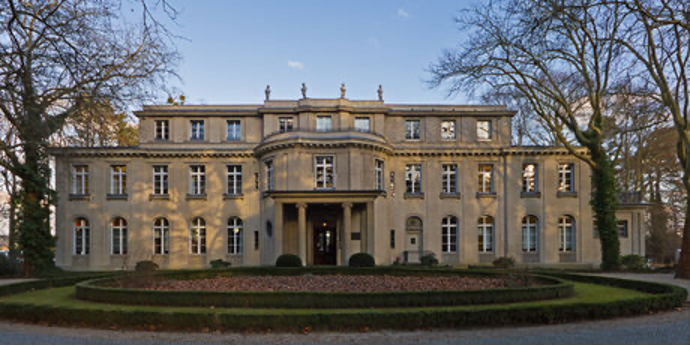
The mansion at Wannsee, just outside Berlin, was the location for a conference with earth-shattering consequences. In 1942, leading figures in the Nazi government and SS met here to discuss their so-called ‘Final Solution to the Jewish Question’. The exhibition in the House of the Wannsee Conference gives an insight into this criminal meeting and how the plan was put into practice. It details the genocide perpetrated on the European Jews, through the use of original documents and audiovisual presentations. The genocide also targeted other minorities, like the Roma or gypsies.
STAGE 6: Polarisation
Extremists drive groups apart and eliminate moderates who may stop the genocide. Moderates and uncommitted people are spied on by neighbours and state propaganda enforces the government’s narrative on the people.
Prevention requires
- Support anti-genocidal groups
- Physically protect moderate leaders
- Protest arrest of moderates and demand release
- Prosecute hate groups for hate speech or incitement
- Take down their websites, Facebook, Twitter etc accounts
STAGE 7: Preparation
Perpetrator leaders build armies, indoctrinate the population with fear of the victim group.
Prevention requires
- Use journalistic, NGO and government intelligence networks
- Publicly expose genocidal plans
- Support political opponents of plans
- Freeze finances and deny visas to planners
STAGE 8: Persecution
Death lists are drawn up. Victims are forcibly relocated. This is the follow-up to the Classification stage and, in the Holocaust, the use to which the IBM punched cards were put.
- Use of hate propaganda in printed and mass media (TV, radio and internet)
- In Rwanda, Tutsis were referred to as cockroaches
- Rwanda witnessed the organisation of extremist Hutu militias – Interahamwe
The Kurdish genocide (the Anfal campaign) was a counterinsurgency operation which was carried out by the Iraqi forces of Sadaam Hussein in the Kurdish region of Iraq from February to September 1988, at the end of the Iran–Iraq War. The campaign targeted rural Kurds because its purpose was to eliminate Kurdish rebel groups and Arabize strategic parts of the Kirkuk Governorate.
The Iraqi forces were led by Ali Hassan al-Majid, who became known as ‘chemical Ali’ because of his use of poison gas on the orders of President Saddam Hussein. The campaign’s name was taken from the title of Qur’anic chapter 8 (al-ʾanfāl).
In 1993, Human Rights Watch (HRW) released a report on the Anfal campaign based on documents captured by Kurdish rebels during the 1991 uprisings in Iraq; HRW described it as a genocide and estimated between 50,000 to 100,000 deaths. Although many Iraqi Arabs reject that there were any mass killings of Kurdish civilians during Anfal, the event is an important element constituting Kurdish national identity.
Prevention requires
- Diplomacy using regional allies
- Targeted sanctions on genocide leaders
- Political asylum for victims
- Prepare relief for refugees
- Arms assistance for victims’ self-defence
- Regional military intervention
STAGE 9: Extermination
Mass killing (legally called “genocide”) begins in a systematic way, always aimed at eliminating a section of the populating based on their ethnic, language or religious characteristics.
- Organised genocidal massacres
- Cooperation between state army and militias
- Not seen by killers as murder
- Victims are filthy “enemies”
- Society needs “cleansing
Prevention or, more often, response to genocide after it has taken place
- Rapid armed international intervention
- UN Security Council authorised, or
- UN General Assembly authorised, or
- Regional organisation sponsored support for local resistance
- Response to genocidal attacks
The Evian conference of 1938
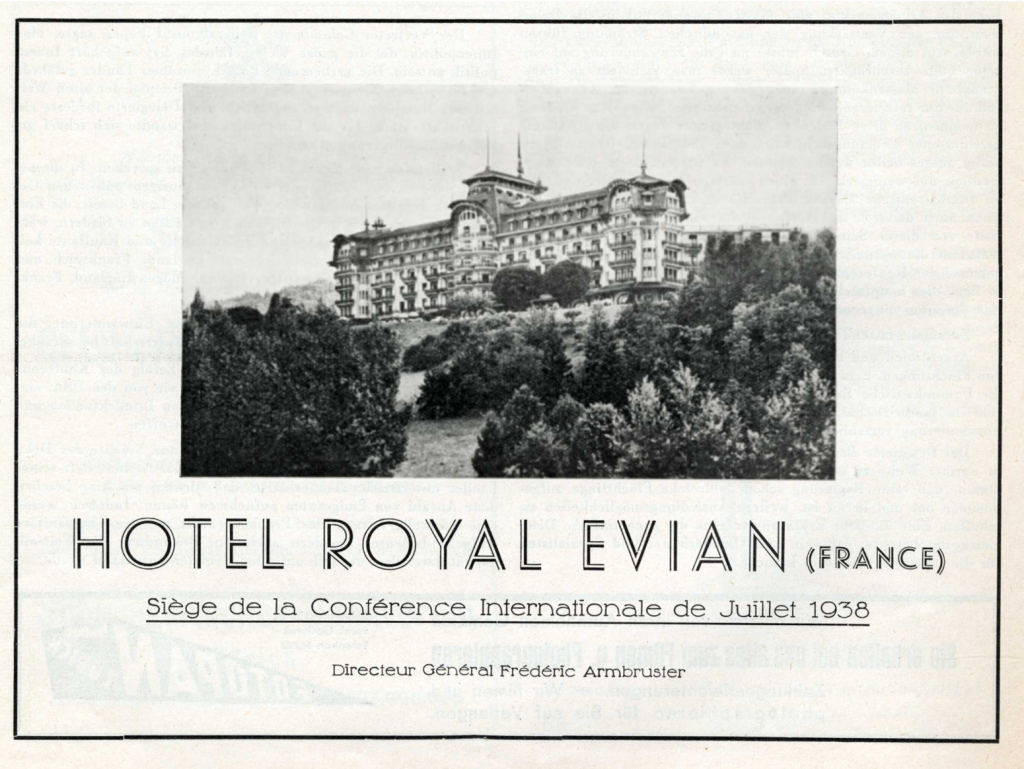
Advertisement promoting the Hotel Royal as the “venue for the international conference of July 1938”.
The Évian Conference was convened 6–15 July 1938 at the Hotel Royal, Évian-les-Bains, France, to address the problem of German and Austrian Jewish refugees wishing to flee persecution by Nazi Germany.
In truth, the Western countries were reluctant to open their doors to Jews from Germany and Austria, and the Zionist leaders were also against immigration to anywhere other than Palestine. The conference gave Hitler a propaganda coup and the opportunity to manifest his intentions to destroy Europe’s Jewish population.
The International Criminal Court
Crimes against humanity are tried at the International Criminal Court (ICC), which was founded on 1st July 2002 and is based at Den Haag in the Netherlands. The Commission for International Justice and Accountability (cijaonline.org) prepares cases relating to ISIS in Syria and Iraq to be heard
Listen to this powerful song by singer/songwriter Al Stewart and the video with it. It very graphically illustrates Stage 9.
Linking the video images to the subtle wording of the lyrics increases the impact of Al Stewart’s song.
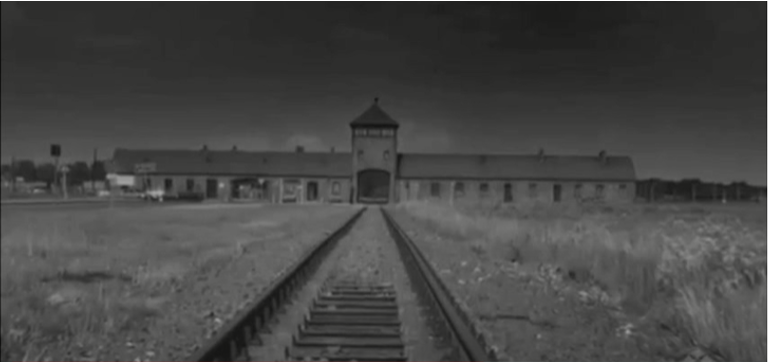
Auschwitz concentration camp, chemical factory and site of vile experiments on human beings set up and operated by the pharmaceutical cartel, I. G. Farben.
STAGE 10: Denial
Perpetrators try to hide evidence of their crimes and continue to govern until removed by force, and they
- Deny that genocide took place
- Minimise deaths
- Blame victims
- Blame “natural causes”
- Call it mutual civil war
- Claim “self defence”
- Lie to create doubts till it’s all over
- Appeal to national interests of potential interveners