
Topic 6: Balance of powers and the European Union constitution.
Walter Hallstein was appointed the first President of the European Economic Community (Forerunner of the European Union) in 1958 and held that office till 1967. Prior to that, he had been an administrator for the Nazi regime, and in 1939, after Germany had annexed Austria and overrun the German-speaking part of Czeckoslovakia, he made a speech outlining how the ‘Greater Germany’ would be administered.
Of course, the Nazi idea of Greater Germany would extend from Vladivostok in the far east of Russia to Brest in the west of France. They planned to rule by a series of Directives, with the Executive branch of government in full control. Hitler did not have any time for democracy.
During the war, Hitler had ruled by means of his War Directives, but the ‘peace directives’ had to wait until Walter Hallstein became Chief Executive of Europe. He had previously helped in the development of a single European state that was fundamentally designed to bypass national sovereignty.
The following images are the cover and title page of Hitler’s War Directives, edited by Hugh Trevor-Roper.

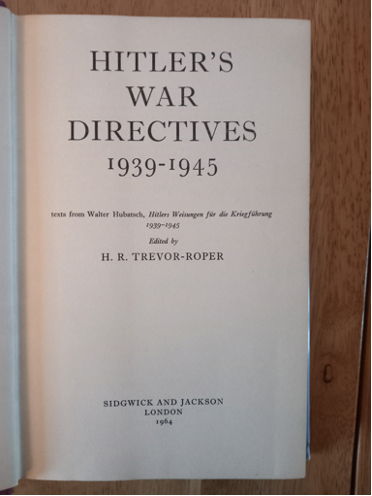
The constitution of the European Union maintains this distortion of the equal balance of powers with a disproportionately strong executive Commission and a weak Parliament that just rubber stamps decisions (Directives) made by the European Commission. Walter Hallstein’s period of office as President of the European Economic Community ended in 1967 over a conflict with General de Gaulle, French wartime leader of the Free French forces who was President of France at the time, over forcing through greater European integration.